… continued
Metamorphosis
About thirty million years ago, the trailing edge of the Farallon Plate began to disappear under North America in the shape of an inverted 90° wedge, beginning at the location of present-day Los Angeles, and proceeding northeast under the continent, leaving nothing but hot mantle where before was the cold, subducting oceanic plate.

Burial of the Farallon Plate
Over the past twenty million years, that trailing edge has been crossing the Sierra Nevada region, and it’s traveled nearly as far north as Mount Lassen thus far, creating a great triangle between the trailing wings of the subducted Farallon Plate and the Pacific Plate.
With no more subduction to trigger the kind of volcanic activity characteristic of Mount Lassen and the Cascade Range to the north, the Sierra Nevada has transitioned into a new phase of plutonic activity. The hot, underlying mantle has pressed up through the great triangle, causing uplift and, as the uplifted dome has increased the surface area above, spreading. The spreading, in turn, has created grabens such as Owens Valley.
Though the stone that makes the Sierra Nevada was formed long before this uplift and spreading, it was this event, beginning about thirty million years ago, that actually gave rise to the Sierra Nevada that we know today. Still, there have been much more recent events that have contributed greatly to the general, large-scale structure of the range.
A New Age of Volcanism
This new incarnation of California lacks the Cascadian volcanism of its past, yet the existence of the eruption of the Long Valley supervolcano 760,000 years ago attests to the volatility of the present-day Sierra Nevada. It was an eruption 500 times the size of the 1980 Mt. St. Helens eruption and 30 times the size of the 1883 Krakatoa eruption, surpassed by only four eruptions over the last million years:
- Lake Toba, Sumatra, Indonesia
- Whakamaru, North Island, New Zealand
- Lake Taupo, North Island, New Zealand
- Yellowstone Caldera, Wyoming, USA
There are no stratovolcanoes along the spine of the Sierra Nevada, but there is evidence of something more terrible.
Localized Foundering of the Farallon Plate
As the trailing edge of the cold, dense Farallon Plate was detached from the supporting mass of any trailing oceanic plate, that trailing edge must have begun to sink — not merely as a caboose follows a train downhill, but rather more directly down, as it was no longer supported on its western boundary.
Delamination and Mantle Drip
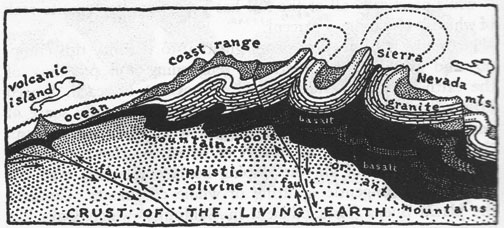
Such a sinking mass must have pulled on the lithosphere above it, and possibly pulled the dense root of the Sierra Nevada downward and away from the mountain range. Once the trailing edge of the subducted plate passed, the detached root of the Sierra — being relatively dense — may have begun to sink more directly into the depths of the mantle, causing local downwelling.

Sinking mountains east of Fresno
Asthenospheric mantle flowed in to fill the gap where the Sierra’s root had been — probably liquefying under reduced pressure, and the Sierra, without the ballast of its dense root, became more buoyant, and began to rise, pulling even more asthenospheric mantle up with it, some of which would have liquefied. As magma, it would have injected itself into cracks in and around the thin Sierra block, ushering in the current phase of Sierra volcanism.
As the delaminated Sierra root descends into Earth’s mantle, it has created a local convection cell. The sinking root is causing downwelling in its wake, and pushing mantle rock downward and outward ahead of it. This downdraft appears to be causing subsidence in the Tulare Basin and the western Sierra adjacent to the basin.
As the displaced mantle rock is pushed aside, it then begins to rise, creating upward pressure at its edges — probably more along one edge, due to asymmetry. The upward pressure creates a local updraft, which may be adding to the uplift of the Sierra.
Further Reading:
Active foundering of a continental arc root beneath the southern Sierra Nevada in California
Watching Whales in the Sink
37.242286-121.730945