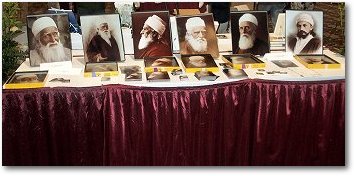
Posts Tagged idols

Our Daily Bread: Ultimate Idols

Posted on Friday, January 2nd, 2009 at 9:15 pm

Today’s slice of divine guidance begins with the obvious: we humans can never have universal, divine knowledge. This is not a problem for those of us who have come to terms with the fact that we cannot know everything.

O Salmán! The door of the knowledge of the Ancient Being hath ever been, and will continue for ever to be, closed in the face of men. No man’s understanding shall ever gain access unto His holy court. …

There are those among us, however, who continue to harbor ambitions for the unattainable. For them, we have religion:

As a token of His mercy, however, and as a proof of His loving-kindness, He hath manifested unto men the Day Stars of His divine guidance, the Symbols of His divine unity, and hath ordained the knowledge of these sanctified Beings to be identical with the knowledge of His own Self. …

There you have it: the solution. God can be known by knowing these special messengers the Baha’i Faith calls “Manifestations of God.” These Manifestations are specially created by God to be the perfect images of God, tuned with precision to the capacities of our minds at any given time. For instance: Jesus was perfect for the Roman era, and Muhammad was perfect for the MIddle Ages. These images of God are so perfect that as humans, the only appropriate response is for us to regard them as God himself:

Whoso recognizeth them hath recognized God. Whoso hearkeneth to their call, hath hearkened to the Voice of God, and whoso testifieth to the truth of their Revelation, hath testified to the truth of God Himself. Whoso turneth away from them, hath turned away from God, and whoso disbelieveth in them, hath disbelieved in God.

—Gleanings from the Writings of Bahá’u'lláh

That’s the ultimate in idolatry, right there. Feast your eyes.

Our Daily Bread: No more questions, thank you!

Posted on Thursday, January 1st, 2009 at 7:25 pm

Happy New Year, everyone!

Today’s slice of sustenance is a reminder of the mind-numbing principle under which I was raised. I remember learning just how much of a problem this would become for me around New Year’s Day, 1988, when my parents stunned me by reacting quite desperately and angrily to my doubts as a young Bahá’í.

Bahá’ís talk a lot about their principle of “independent investigation of truth,” but this only applies to those who haven’t yet found the truth—the Bahá’í Faith. Since I was born a Bahá’í, there was nothing for me to investigate:

what would it profit any man to strive after learning when he hath already found and recognized Him Who is the Object of all knowledge?

—Gleanings from the Writings of Bahá’u'lláh

But that’s not all. It’s not enough to cease looking for truth; it’s equally important to abstain entirely from questioning Bahá’u'lláh:

Blessed is the man that hath acknowledged his belief in God and in His signs, and recognized that “He shall not be asked of His doings”. Such a recognition hath been made by God the ornament of every belief and its very foundation. Upon it must depend the acceptance of every goodly deed. Fasten your eyes upon it, that haply the whisperings of the rebellious may not cause you to slip.

—Bahá’u'lláh, Kitáb-i-Aqdas

The question and answer period has ended.

This insight—this epiphany—gave special meaning to “New Year” for me at the outset of 1988. Within six months, pending long days and nights of reconsideration and reflection, I would completely detach myself from any belief in my religion of birth.

Our Daily Bread: The Twin Duties

Posted on Sunday, December 14th, 2008 at 2:45 pm

Any given religion can mean a variety of things to its adherents. The religion I was raised in, the Bahá’í Faith, is no exception to that rule of thumb, though that changed substantially with the long-overdue publication of Bahá’u'lláh’s “Most Holy Book” in 1993, five years after I had left the Bahá’í Faith. The book provides a definitive, unambiguous “mission statement” for the Bahá’í religion that runs counter to the pluralistic vision that some Bahá’ís had embraced previously.

The statement begins by declaring that the author is the sole representative of God in the universe and that men are duty-bound to recognize him as such:

The first duty prescribed by God for His servants is the recognition of Him Who is the Dayspring of His Revelation and the Fountain of His laws, Who representeth the Godhead in both the Kingdom of His Cause and the world of creation.

Bahá’u'lláh then goes on to state that those who recognize his exclusive divine authority are the good guys, and everyone else, however virtuous, is lost. Authority trumps morality.

Whoso achieveth this duty hath attained unto all good; and whoso is deprived thereof hath gone astray, though he be the author of every righteous deed.

However, he adds this critical afterthought: believers, though they have “attained unto all good,” must also be absolutely obedient.

It behoveth every one who reacheth this most sublime station, this summit of transcendent glory, to observe every ordinance of Him Who is the Desire of the world. These twin duties are inseparable. Neither is acceptable without the other.

Note that there are no concessions made to virtue per se. The only virtues recognized by Bahá’u'lláh are recognition of him and obedience to him.

Killing your Buddhas

Posted on Saturday, October 25th, 2008 at 10:37 pm

Continuing our discussion of the correspondences between Heraclitus and the Zarathustras, we have the directive that each one find truth for oneself; that one must never follow. As the old Buddhist epigram goes, “if you meet the Buddha on the road, Kill him.” Heraclitus, likewise, bids his readers not to listen to him, but rather to the Logos. Heraclitus also says “eyes are better witnesses than ears.”

Peters Denial of Jesus

Nietzsche’s Zarathustra, likewise, is intent upon shaking off his disciples, for their own good:

Verily, I counsel you: go away from me and guard yourselves against Zarathustra! And better still: be ashamed of him! Perhaps he has deceived you. … One repays a teacher poorly if one always remains only a student.

— Thus Spoke Zarathustra 1.22.3: On Bestowing Virtue

Zarathustra continues, cautioning his disciples against idolizing him:

You revere me; but what if your reverence should someday collapse? Be careful lest a statue fall and kill you!

— Thus Spoke Zarathustra 1.22.3: On Bestowing Virtue

As Heraclitus says, “I went in search of myself”, so Zarathustra instructs his disciples to do the same:

Now I bid you lose me and find yourselves; and only when you have all denied me will I return to you.

— Thus Spoke Zarathustra 1.22.3: On Bestowing Virtue

This sounds curiously similar to the story of Peter’s denial of Jesus:

Peter said unto him, Lord, why cannot I follow thee now? I will lay down my life for thy sake. Jesus answered him, Wilt thou lay down thy life for my sake? Verily, verily, I say unto thee, The cock shall not crow, till thou hast denied me thrice.

— John 13:37–38

In a sense, I can personally claim to have been similarly instructed by the Idol of my youth, Bahá’u'lláh, who chased me off with his manifold contradictions while he subtly—perhaps unintentionally—instructed me in the ways of divine Godlessness.

Unfortunately, I know of no doctrine of virtuous denial in Bahá’u'lláh’s writings.

The Perfect Sin

Posted on Saturday, October 11th, 2008 at 11:22 pm

Here’s my latest PowerPoint presentation, saved as a movie, then merged with an audio file with QuickTime and exported. The subject is idolatry (don’t act so surprised!) and Islam. The soundtrack is Mozart’s “Laudate Dominum” sung by Maria Zadori, one of my all-time favorites.

The QuickTime plugin is necessary for viewing. A lower quality version can be found on YouTube.

I considered “James Dean” by the Eagles for an ironic twist, but solemnity won out over humor in the end, and besides, there’s ample irony in using a idolatrous prayer as the soundtrack for this sequence.

The lyrics:

Laudate Dominum omnes gentes
laudate eum, omnes populi
Quoniam confirmata est super nos misericordia ejus,
et veritas Domini manet in aeternum.

Gloria Patri, et Filio et Spiritui Sancto.
Secut erat in principio, et nunc, et simper,
et in saecula saeculorum. Amen

And in English:

O praise the Lord, all ye nations;
Praise him, all ye peoples
For his loving kindness has been bestowed upon us,
and the truth of the Lord endures for ever.

Glory be to the Father, and to the Son, and to the Holy Spirit.
As it was in the beginning, is now, and ever shall be,
world without end. Amen.

I haven’t, as of yet, been able to upload the movie at full quality to YouTube. Perhaps YouTube has trouble processing the fade transition between slides, as removing those transitions appears to enable YouTube to process the file. So here it is, posted on the blog. This required that I do some customization of my blog header file, which was a bit of a hassle.

Our Daily Bread: Idols ‘r’ Us

Posted on Wednesday, September 17th, 2008 at 2:32 pm
Abbas Abbas Everywhere

Abbas Abbas Everywhere!

Today’s slice of enlightenment is our first contribution from the pen of `Abdu’l-Bahá’, the son of the second, greater Bahá’í Manifestation:

If you seek immunity from the sway of the forces of the contingent world, hang the ‘Most Great Name’ in your dwelling, wear the ring of the ‘Most Great Name’ on your finger, place the picture of `Abdu’l-Bahá in your home and always recite the prayers that I have written. Then you will behold the marvelous effect they produce. Those so-called forces will prove but illusions and will be wiped out and exterminated.

—Lights of Guidance, page 520*

This explains a lot. It helps us to better understand why Bahá’ís are so fond of talismans, rote recitation, and graven images of their most charismatic and photogenic leader.

* Word has it that this passage is from a letter addressed to Ms. Emma Ort, cited in a UHJ letter and in the original Persian in Safínih-i ‘Irfán volume 7, page 22.

Our Daily Bread: Partners of God

Posted on Tuesday, September 16th, 2008 at 11:34 pm

Anyone who claims to be on God’s side is a polytheist. To be a true monotheist, one must be either a strict determinist or an agnostic (with regard to the will of God).

I’ve been known to throw around the terms “idol” and “partner of God” ad nauseam among friends. It’s a chip that seems to have appeared on my shoulder during my employment at the Bahá’í World Centre, where a particularly high saint-per-capita ratio gave me some food for thought. Since that time, I’ve slowly come to regard the believers of the Judaic tradition (including most Jews, Christians, Muslims, Bahá’ís, etc.) as worshipers in various polytheistic partnerships and rivalries.

I get the term “partnership” from Islám. The Qur’án makes it clear that God has no partners, and needs no help from anybody.

الْحَمْدُ لِلّهِ الَّذِي لَمْ يَتَّخِذْ وَلَدًا وَلَم يَكُن لَّهُ شَرِيكٌ فِي الْمُلْكِ وَلَمْ يَكُن لَّهُ

All praise is due to God, who begets no offspring, and has no partner in His dominion, and has no weakness, and therefore no need of any aid. (17.111)

The most literal meaning of the term “shirk” (شرك‎) is a lesser god who might help or otherwise harm God or his cause. Thus, anyone who would diminish his belief in God’s omnipotence by ascribing any power whatsoever to any being other than God would be guilty of this offense. The classic example of this offense is the Christian worship of Christ, as the alleged son and accomplice of God, but the problem of partnership goes much deeper.

Any free agent (individual) with any influence whatsoever must be seen as a partner or rival of God. Some might assert that this is not applicable to the Islamic notion of partnership, because people don’t worship people, but don’t they? Isn’t the attribution of any power whatsoever to any free entity the deification of that entity?

How many self-professed Muslims, I wonder, truly internalize the mantra “all praise be to God (الْحَمْدُ لِلّهِ)”?

This is not a problem for the traditional, deterministic Sunni, the Calvinist Christian, or for Zoroastrians who believe in freewill but not in an omnipotent God (partnership is virtuous in Zoroastrianism); but it is a serious indictment of any observant Muslim who claims to be a free monotheist, with one possible exception.

Many people consider themselves believers in an all-powerful God and at the same time consider the destinies of individuals and society to be up to others than God, but that is not really monotheism; rather, it is a form of polytheism, where the pantheon consists of billions of lesser gods that we casually call immortal souls. The Big God—call him Zeus—may have the power to frustrate the wills of any of these minor Gods, or even punish them for all eternity, but notice: He has never claimed to be able to annihilate a soul; not, at least, for a very long time.

But that Zeus is not the God of the inshá’alláh (إن شاء الله) Muslim. That Muslim’s God, so dominant in the Qur’án, is a God who meddles with the intentions of men; who “seals the hearts of men” as he deems appropriate. He is truly omnipotent, and the only will that men possess is a gift (or a curse) from Him. In other words, all individual will is an expression of divine will.

Blessed is He Who doeth as He willeth by a word of His command. He, verily, is the True One, the Knower of things unseen. Blessed is He Who inspireth whomsoever He willeth with whatsoever He desireth, through His irresistible and inscrutable command. Blessed is He Who aideth whomsoever He desireth with the hosts of the unseen. His might is, in truth, equal to His purpose, and He, verily, is the All-Glorious, the Self-Subsisting. Blessed is He Who exalteth whomsoever He willeth by the power of His sovereign might, and confirmeth whomsoever He chooseth in accordance with His good pleasure; well is it with them that understand! —Súriy-i-Haykal

There is, I suppose, one loophole out of all this for the non-deterministic monotheist: if one were not to claim to be on God’s side, perhaps—say, because one considers the will of God to be utterly inscrutable, one need not be tried as a polytheist in the court of strict monotheism. It is, after all, hard to partner up with God if one doesn’t know what God wants.

This would, of course, require a degree of modesty rarely exhibited among believers, and any mention of divine covenants or pacts would immediately disqualify the believer from this exemption.

Our Daily Bread: They Who Know what God Knows

Posted on Sunday, September 14th, 2008 at 4:06 pm

Today we’re having more fun with Bahá’u'lláh’s Book of Certitude …

Bahá’u'lláh cites verse 3.7 (3.6 according to some) of the Qur’án twice in his Book of Certitude. Here’s how Shoghi Effendi (the second successor of Bahá’u'lláh) translated the passage (he translates each citation differently):

None knoweth the interpretation thereof but God and they that are well-grounded in knowledge.

None knoweth the meaning thereof except God and them that are well-grounded in knowledge.

This seems to be saying “no one knows except those who know.” How absurdly circular! But in defense of the Qur’án, every broadly-recognized English translation of that book makes it quite clear that this is not what the Qur’án is saying.

Pickthall:

None knoweth its explanation save Allah. And those who are of sound instruction say: We believe therein; the whole is from our Lord;…

Yusuf ‘Alí:

no one knows its hidden meanings except Allah. And those who are firmly grounded in knowledge say: “We believe in the Book; the whole of it is from our Lord:”

Rodwell:

none knoweth its interpretation but God. And the stable in knowledge say, ‘We believe in it: it is all from our Lord.’

It turns out, though, that all these translations represent the dominant Sunni point of view, that the ultimate meaning of the Qur’án is known only to God. The Shí’a read it differently, as exemplified by Maulana Muhammad `Alí’s Ahmadiyyah translation:

And none knows its interpretation save Alláh, and those firmly rooted in knowledge.

The Shí’a reading, that “only the knowers know” turns out to be the scriptural foundation for the idolatrous Shí’ah doctrine of ta’wil.

What’s so idolatrous about it? First, if men can achieve perfect, divine, knowledge, then men can become equals—or at least partners—of God. They can become infallible, as the Twelver Shí’a regard their “14 infallibles”. By the same reasoning, it is also an elitist doctrine, thereby contrary to what many Muslims consider to be the egalitarian spirit of Islám. Second, if the Qur’án is the perfect word of God and it can be understood perfectly, then the Qur’án itself is an idol; a divine image.

Ok, so it’s idolatrous, but what’s wrong with a little divine imagery? Here’s what’s wrong with it. If a man makes an idol of an image, he becomes enslaved to that image. If a man makes an idol of an idea, he becomes enslaved to that idea. If a man makes an idol of another man, he becomes enslaved to that man.

The whole thrust of Islam is against this kind of enslavement to anyone or anything but God, yet it is a hard lesson to learn. Even though the Qur’án makes it clear that Muhammad was a man who could err and be scolded by God, most Muslims have made Muhammad superhuman, and the Shí’a—particularly the Baháí—have made him an image of God.


We should not be surprised that Bahá’u'lláh, himself a Shí’a, puts such emphasis on the Shí’a interpretation of an ambiguous verse:

And yet, they themselves testify to this verse: “None knoweth the interpretation thereof but God and they that are well-grounded in knowledge.” And when He Who is well-grounded in all knowledge, He Who is the Mother, the Soul, the Secret, and the Essence thereof, revealeth that which is the least contrary to their desire, they bitterly oppose Him and shamelessly deny Him. —Kitáb-i-Íqán

Even as He saith: “None knoweth the meaning thereof except God and them that are well-grounded in knowledge.” And yet, they have sought the interpretation of the Book from those that are wrapt in veils, and have refused to seek enlightenment from the fountain-head of knowledge. —Kitáb-i-Íqán

So let’s not blame the translator, even though he cannot decide between the words “they” and “them” (who can blame him?).

Our Daily Bread: Narcissus

Posted on Monday, September 8th, 2008 at 2:03 pm

It is evident that, for all of his faults, Bahá’u'lláh had no lack of self-esteem:

Would ye laugh to scorn and contend with Him, a single hair of Whose head excelleth, in the sight of God, all that are in the heavens and all that are on the earth?
—Suriy-i-Haykal (Sura of the Temple)

This passage helps us to understand why Bahá’u'lláh let his hair grow so wildly, in spite of forbidding long hair in his book of laws.

This “Sura of the Temple” is also known as the “Sura of the Body”.

John Walbridge writes:

In the Súratu’l-Haykal the primary sense of haykal is the human body, particularly the body of the Manifestation of God, …

Adib Taherzadeh reported in Revelation of Bahá’u'lláh that Bahá’u'lláh wrote that he was both the author and the addressee of this Tablet. We can almost hear Bahá’u'lláh crying into the reflection pool, “make Me to be thine Idol!”

For more information, see Tablet of the Temple by Jonah Winters.

Our Daily Bread: The Good, the Bad, & the Idol

Posted on Wednesday, August 27th, 2008 at 8:08 pm

I’ve got a pile of quotations that I don’t know what to do with, so I’m going to attempt to process them by means of a new quote of the day feature.

Let’s start with one from Baha’u'llah’s Sura of the Temple (Suriy-i-Haykal), a sura that was not published in English until 2002, about 133 years after its final revision (that’s right, this scripture underwent a revision process).

Today’s slice is a passage that made the final cut, concerning the personification of Good and Evil.

“The Evil One hath appeared in such wise as the eye of creation hath never beheld. He Who is the Beauty of the All-Merciful hath likewise been made manifest with an adorning the like of which hath never been witnessed in the past. The Call of the All-Merciful hath been raised, and behind it the call of Satan.” —Baha’u'llah

I wonder how one is expected to interpret the closing sentence. Is the call of Satan behind the call of God, such that it might be thought to be coming from the same direction? From the same source?

I doubt that any Baha’i would interpret the phrase He Who is the Beauty of the All-Merciful as anything but an explicit reference to the author, Baha’u'llah. Thus God is once again made flesh, but that’s nothing new.

What’s also interesting about this passage is that Baha’u'llah is juxtaposed against the Evil One. Is Satan also manifested as is God?

I know. I know. Baha’is say they don’t believe in Satan. Perhaps, but I have no doubt that Baha’is are taught to be wary of dark, dangerous, and infectiously evil souls. So is it not likely, then, that one soul in particular has come to manifest a Satanic spirit? If so, who is this masked man?

Could it be … Baha’u'llah?

© 2006-2012 Dan Jensen All Rights Reserved -- Copyright notice by Blog Copyright