Clough Cave is not the only cave in the South Fork area. There are four that I have heard of, one of which was discovered in 2006 and featured in National Geographic. Hundreds of such caves occur in marble outcrops which appear in the Sierra’s eroding meta-sedimentary shell. There are at least a half dozen such outcrops in the South Fork area.
At South Fork Campground we are confronted by a choice between (a) following the river to Ladybug and (b) ascending up the south face of the canyon.
The original Hockett Trail stayed near the river to just beyond Ladybug. This is the most direct route, but it requires two additional river crossings, and adds a very steep ascent after Ladybug.
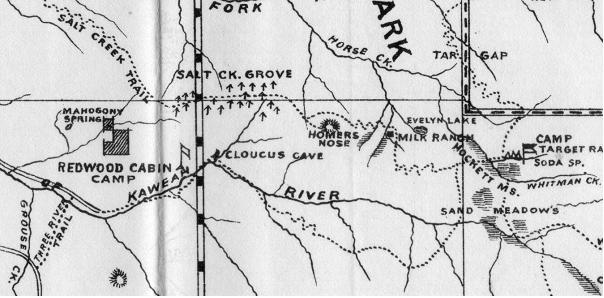
The difficulty of the second crossing is not trivial. It is in a small gorge, and the river rushes precipitously downhill there. I lost a water bottle several years back attempting to ford the river just upstream. The last bridge that crossed at Ladybug was washed out (as were others) in the winter of 1969. After that, the Hockett Trail was no longer maintained from end to end, unless one considers the Garfield-Hockett Trail a branch of the Hockett Trail, which I do.
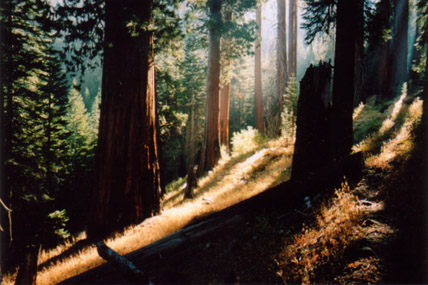
The reasons I have for considering the high route through Garfield Grove to be part of the Hockett Trail are:
- it is probably a superior route to the original one that was abandoned in 1969
- it serves all the needs of the original trail
- it is adjacent to the original trail and rejoins it quickly
The original trail does avoid snow in the early season, but I’ll take snow over snow melt just about every time. Consider Christopher McCandless.
Still, Ladybug is a great spot for trout fishing and, of course, lady bugs.
My friend Juan and I recently attempted to follow the old ascent up the big hill, but found that it was every bit as overgrown as we had been told. We found ourselves crawling through low-lying tunnels under thickets, hoping to come though to an opening, but the tunnels just kept on going.
Nothing that a good fire couldn’t fix.
The alternative is a long, strenuous haul up the north side of Dennison Ridge, but it offers plenty of shade, moderate slopes, frequent water sources, beautiful forests, stately campsites and all without any drowning hazard. Even with ice on the ground, this route is quite safe in most places.
| One of the last wild nesting sites of the California condor before its reintroduction was a fire scar in a giant Sequoia tree, just on the other side of Dennison Ridge. Dennison Ridge, Dennison Peak, and Dennison Mountain get their names from a mountaineer who blazed the first trail across the southern Sierra. It is said that he died after stumbling over his own bear snare, just on the other side of this ridge that bears his name. |  |
Legal camping on the Garfield route begins at Snowslide Camp, just beyond Snowslide Canyon, source of the infamous 1876 slide, what I like to call the “Centennial Slide” as a mnemonic. Downstream, at canyon bottom where the slide planted a small Sequoia grove, is the first legal campsite along the old route: Ladybug Camp. Above Ladybug, the old trail gets mighty steep and dry, so there isn’t really any other good camping along this leg of the old route.
See Exploring the Southern Sierra: West Side by Jenkins & Jenkins: Hockett Lakes–Summit Lake Backpack (T86) and South Fork Kaweah River Day Hike (T87).
Hello-
So you have attempted to follow the original Hockett Trail from Ladybug Camp to where it exisits today?
I too have tried, but I was solo and it’s a bit creepy back in there…
I was actually up there last weekend and came across a crew of 10 on a bigfoot hunting expedetion!
I would like to hear how far you made it, and if you would be attempting it again soon. I would like to join you if possible.
Also, I would like to know if you have ever found any other caves up there besides Clough.
I consider myself a local and have been all over this area, but I know there is a lot I have yet to see up there.
Hi Bill,
Bigfoot hunters? That *is* pretty creepy. In the Sierra even. Maybe that’s just what Bigfoot was thinking: “nobody will look for me in the Sierra.” Maybe he should try Berkeley!
My friend Juan and I followed the route maybe several hundred vertical feet. We passed a large clearing then encountered a deep and wide thicket. We tried tunneling under, with our packs getting snagged here and there, before I decided to turn back.
If I had another enthusiast such as you along, I might try harder next time. I might try harder to work around the thicket, or even just keep tunneling. Send me an email.
As for caves, I think that if you join a spelunking club you’d probably find out about the caves. I have not as yet gone that route, but it sounds like fun.
-Dan